
Velocità, parola, visione · Villa Casati Stampa
Balla
Giacomo Balla, 1871–1958 — Elaborazione grafica
Quando nasce il Futurismo, Giacomo Balla ha quasi quarant'anni. È il più anziano del gruppo e, per certi versi, il maestro degli altri: a Roma, nel suo studio, si erano formati due giovani pittori destinati a diventare protagonisti del movimento, Umberto Boccioni e Gino Severini.
È nato a Torino nel 1871. Si stabilisce a Roma alla fine dell'Ottocento e lavora a lungo come pittore divisionista: dipinge la luce scomponendola in piccoli tocchi di colore puro accostati, che l'occhio ricompone guardando. È una pittura che studia come vediamo, prima ancora di che cosa vediamo. Questa attenzione alla percezione sarà il filo conduttore di tutto il suo lavoro.
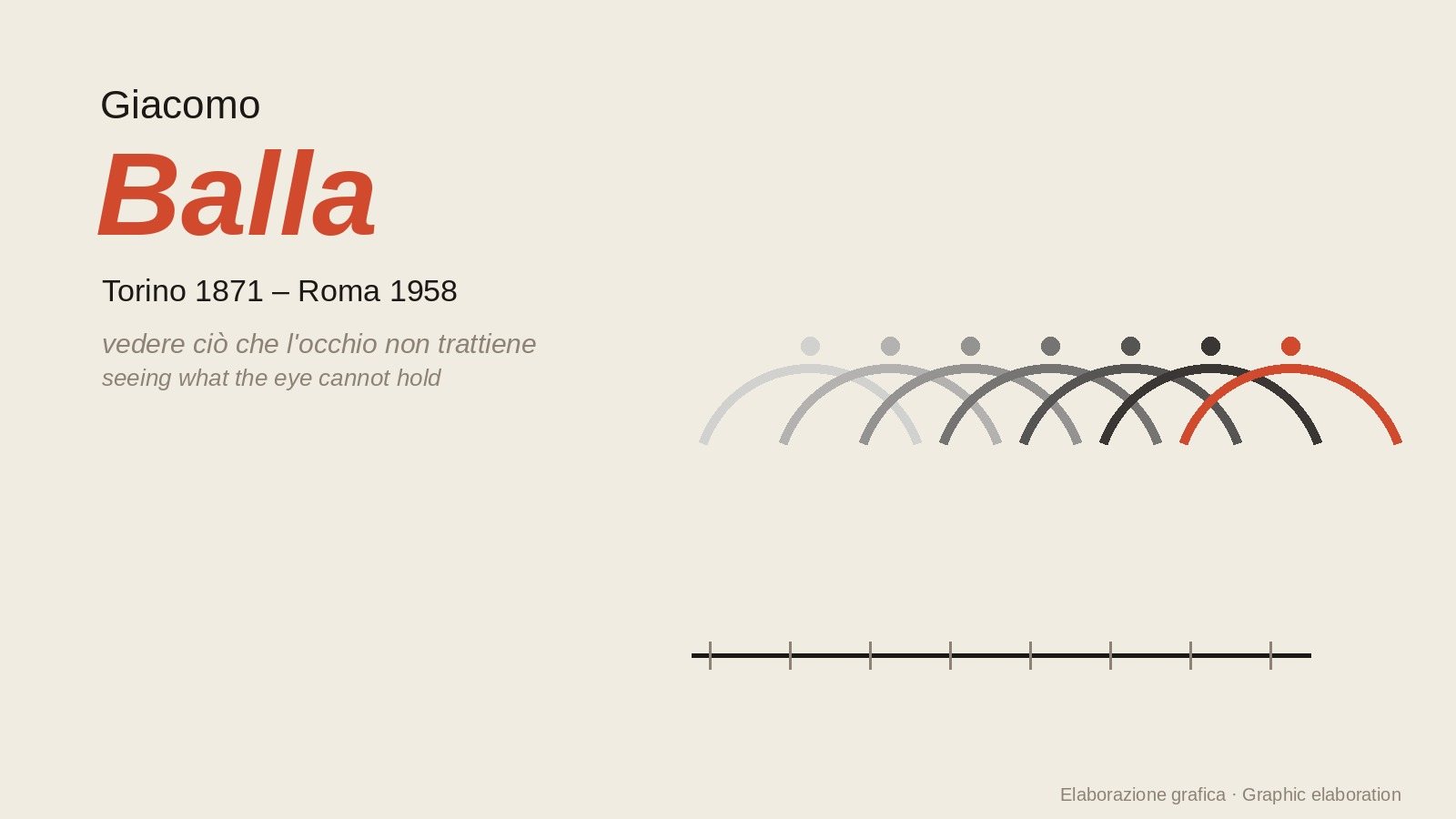
Nel 1910 firma il manifesto dei pittori futuristi. Negli anni successivi la sua domanda diventa precisa: come si può mostrare, in un quadro immobile, il tempo che passa? Balla osserva figure che corrono, animali che camminano, automobili che sfrecciano, e prova a dipingere non il singolo istante, ma la successione degli istanti. Il soggetto si moltiplica, si scompone, poi quasi scompare, lasciando solo traiettorie e linee di forza. Accanto a queste ricerche studia la luce e il colore in sé, in composizioni di triangoli e prismi che non rappresentano più alcun oggetto.
Nel 1915 firma con Fortunato Depero la Ricostruzione futurista dell'universo: il Futurismo deve uscire dal quadro ed entrare nella vita di tutti i giorni. È la soglia verso la sala successiva.
Balla continuerà a lavorare per oltre quarant'anni, fino alla morte, a Roma, nel 1958. Questa sala si concentra sugli anni in cui la sua ricerca prende forma: per capire la velocità, ci invita prima di tutto a fermarci e a guardare.
English
When Futurism was born, Giacomo Balla was almost forty. He was the oldest in the group and, in some ways, the teacher of the others: in his studio in Rome two young painters had trained who would become leading figures of the movement, Umberto Boccioni and Gino Severini.
He was born in Turin in 1871. He settled in Rome at the end of the nineteenth century and worked for many years as a Divisionist painter: he painted light by breaking it into small touches of pure colour placed side by side, which the eye recombines as it looks. It is a painting that studies how we see, even before what we see. This attention to perception would be the common thread of all his work.
In 1910 he signed the manifesto of the Futurist painters. In the following years his question became precise: how can a still painting show time passing? Balla observed running figures, walking animals, speeding cars, and tried to paint not the single instant but the succession of instants. The subject multiplies, breaks apart, then almost disappears, leaving only trajectories and lines of force. Alongside this research he studied light and colour in themselves, in compositions of triangles and prisms that no longer represent any object.
In 1915 he signed with Fortunato Depero the Futurist Reconstruction of the Universe: Futurism had to leave the canvas and enter everyday life. It is the threshold to the next room.
Balla would keep working for more than forty years, until his death in Rome in 1958. This room focuses on the years when his research took shape: to understand speed, it invites us first of all to stop and look.