
Velocità, parola, visione · Villa Casati Stampa
Depero
Fortunato Depero, 1892–1960 — Elaborazione grafica
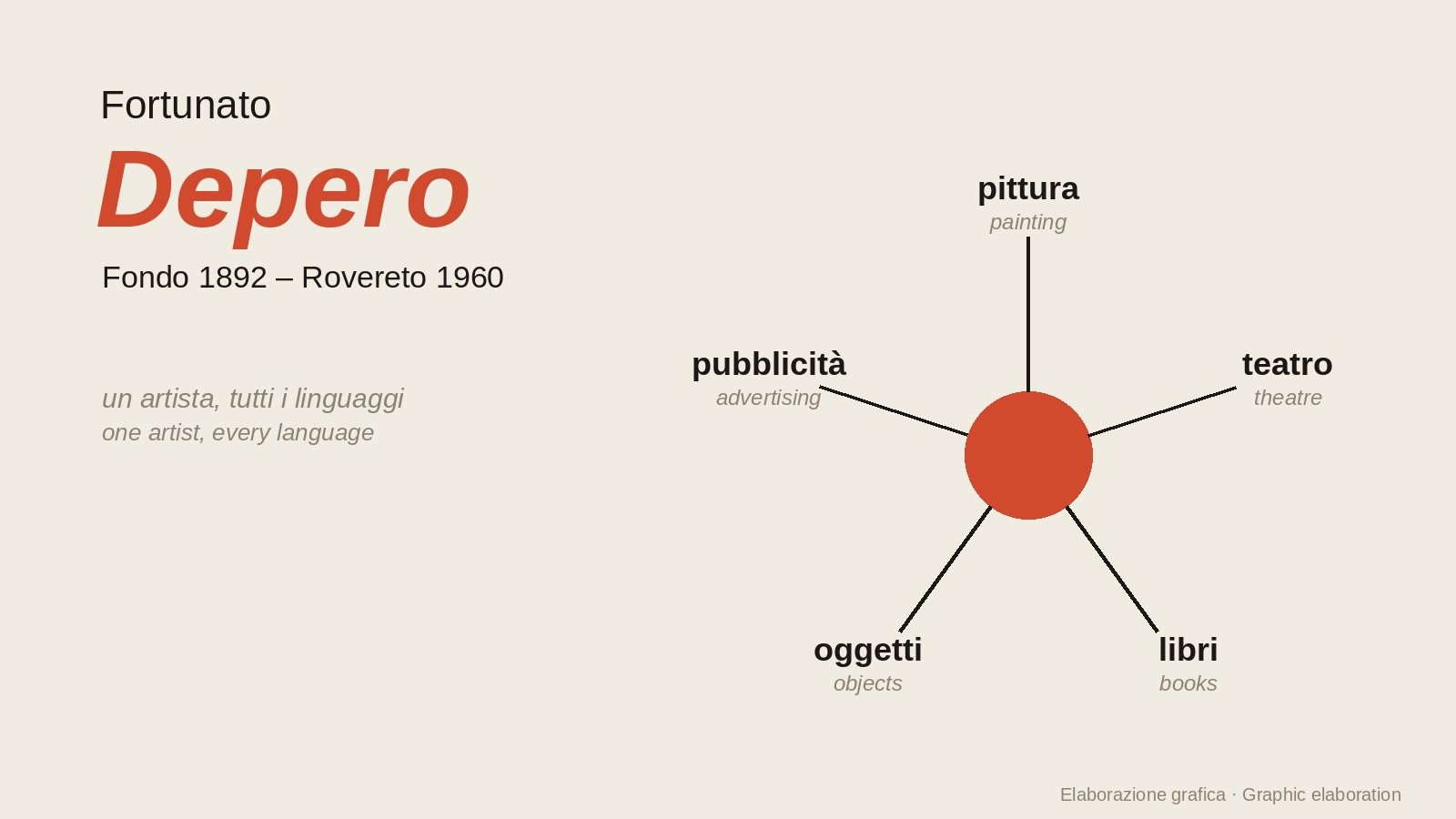
Per Fortunato Depero un'idea poteva diventare un quadro, un mobile, un giocattolo, uno spettacolo o un manifesto pubblicitario. Non cambiava l'idea: cambiava il linguaggio.
È nato nel 1892 a Fondo, in Trentino, e cresce a Rovereto. Nel 1913 arriva a Roma, dove incontra Giacomo Balla, Marinetti e il gruppo futurista. Due anni dopo firma con Balla un manifesto dal titolo ambizioso, Ricostruzione futurista dell'universo: il Futurismo, sostengono, non deve restare dentro i quadri, ma entrare nelle case, nei vestiti, negli oggetti di ogni giorno.
Depero prende quella promessa alla lettera. Nel 1918 porta in scena a Roma i Balli plastici, uno spettacolo senza attori, con marionette e figure meccaniche. Da qui nascono gli omini che popoleranno tutto il suo lavoro: corpi fatti di cilindri, coni e dischi, a metà tra il burattino e la macchina. I due pupazzi che vedete in questa sala sono riproduzioni in stampa 3D di queste figure.
Nel 1919 fonda a Rovereto la Casa d'Arte Futurista, un laboratorio in cui realizza, con la moglie Rosetta Amadori, arazzi, mobili, giocattoli e manifesti. Nel 1927 pubblica il Libro imbullonato, un volume tenuto insieme da due bulloni, che raccoglie il suo lavoro come fosse un oggetto industriale.
È in questo percorso che entra Campari. Secondo la storia ricostruita dalla Galleria Campari, Davide Campari nota Depero alla Biennale di Venezia del 1926. Tra il 1926 e il 1936 l'artista realizza per l'azienda un centinaio di grafiche pubblicitarie, oggetti e arredi. Le figure meccaniche, le lettere che diventano immagine, il nome del prodotto che si fa architettura: tutto il repertorio futurista entra nella comunicazione di ogni giorno.
Per questo Depero è uno dei protagonisti più originali del Futurismo. Non ha applicato l'avanguardia alla pubblicità: ha mostrato che la pubblicità poteva essere un campo dell'avanguardia.
English
For Fortunato Depero an idea could become a painting, a piece of furniture, a toy, a show or an advertising poster. The idea did not change: the language did.
He was born in 1892 in Fondo, in Trentino, and grew up in Rovereto. In 1913 he arrived in Rome, where he met Giacomo Balla, Marinetti and the Futurist group. Two years later he signed with Balla a manifesto with an ambitious title, Futurist Reconstruction of the Universe: Futurism, they argued, should not stay inside paintings, but enter homes, clothes and everyday objects.
Depero took that promise literally. In 1918 he staged the Plastic Dances in Rome, a show without actors, with puppets and mechanical figures. From here came the little men who would populate all his work: bodies made of cylinders, cones and discs, halfway between puppet and machine. The two figures you see in this room are 3D-printed reproductions of these characters.
In 1919 he founded the House of Futurist Art in Rovereto, a workshop where, with his wife Rosetta Amadori, he made tapestries, furniture, toys and posters. In 1927 he published the Bolted Book, a volume held together by two bolts, presenting his work as if it were an industrial object.
This is where Campari comes in. According to the history reconstructed by Galleria Campari, Davide Campari noticed Depero at the 1926 Venice Biennale. Between 1926 and 1936 the artist produced for the company around a hundred advertising graphics, objects and furnishings. Mechanical figures, letters turned into images, the product's name turned into architecture: the whole Futurist repertoire entered everyday communication.
That is why Depero is one of the most original figures of Futurism. He did not apply the avant-garde to advertising: he showed that advertising could be a field of the avant-garde.