
Velocità, parola, visione · Villa Casati Stampa
Diffondere
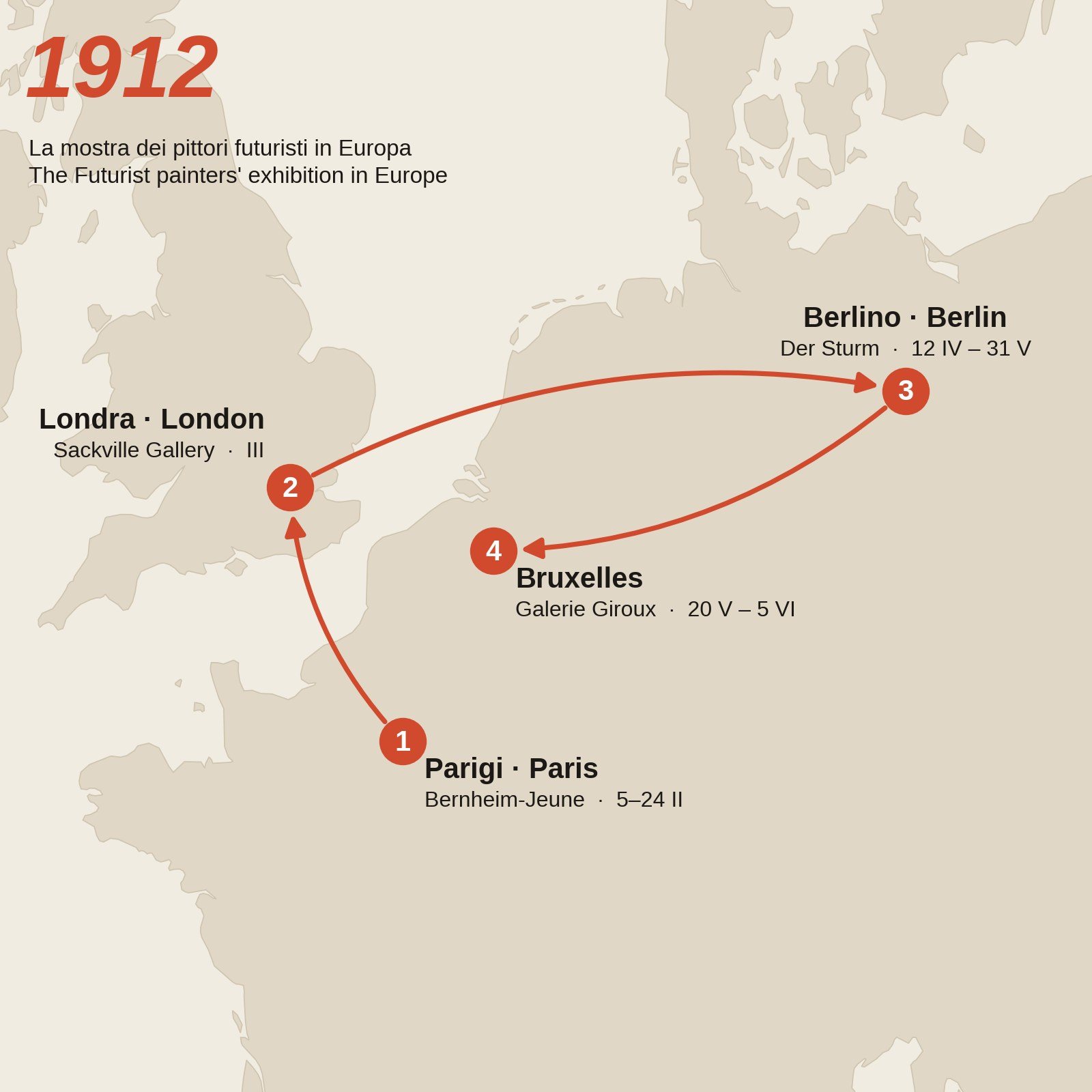
Parigi, Londra, Berlino, Bruxelles, 1912 · Paris, London, Berlin, Brussels, 1912
Quattro copertine, quattro città, tre lingue. Tra febbraio e giugno del 1912 la stessa mostra dei pittori futuristi attraversa l'Europa: a ogni tappa cambia il catalogo, non il messaggio.
La prima tappa è la più rischiosa. Parigi è la capitale dell'arte moderna, e i futuristi vi arrivano sfidando proprio il linguaggio che lì domina, il cubismo. Qualche mese prima Boccioni e Carrà erano andati a vederlo da vicino, guidati da Severini, che a Parigi viveva e conosceva gli ambienti giusti. Alla galleria Bernheim-Jeune espongono Boccioni, Carrà, Russolo e Severini. Balla, che pure aveva firmato il manifesto, non c'è.
Il catalogo si apre con un testo firmato dagli artisti e rivolto direttamente al pubblico. È lo stesso metodo dei manifesti e delle serate: prima di guardare i quadri, il visitatore riceve istruzioni su come guardarli.
La critica parigina è divisa, spesso scettica. Ma l'obiettivo non è l'approvazione, è la presenza: se ne parla, si discute, si prende posizione. A Londra, alla Sackville Gallery, la stampa se ne occupa ampiamente. A Berlino la mostra è ospitata da Der Sturm, la galleria e rivista di Herwarth Walden, uno dei centri dell'avanguardia tedesca. A Bruxelles, alla Galerie Giroux, il giro si chiude.
Rispetto al 1909 il salto è evidente. Allora c'era un testo in un giornale; ora ci sono quadri che viaggiano, gallerie che li ospitano, cataloghi tradotti, recensioni in più lingue. Il movimento ha imparato a muoversi come un'organizzazione internazionale, e Marinetti ne tiene i fili: contatti, spedizioni, rapporti con la stampa.
In tre anni il Futurismo è passato da una pagina di giornale a un circuito europeo. Da qui in avanti, chi discute di avanguardia in Europa deve fare i conti anche con gli italiani.
English
Four covers, four cities, three languages. Between February and June 1912 the same exhibition of the Futurist painters crosses Europe: at each stop the catalogue changes, the message does not.
The first stop is the riskiest. Paris is the capital of modern art, and the Futurists arrive there challenging the very language that dominates it: Cubism. A few months earlier Boccioni and Carrà had gone to see it at close range, guided by Severini, who lived in Paris and knew the right circles. At the Bernheim-Jeune gallery, Boccioni, Carrà, Russolo and Severini exhibit. Balla, although he had signed the manifesto, is absent.
The catalogue opens with a text signed by the artists and addressed directly to the public. It is the same method as the manifestos and the evenings: before looking at the paintings, visitors are told how to look at them.
Parisian critics are divided, often sceptical. But the aim is not approval; it is presence: people talk, argue, take sides. In London, at the Sackville Gallery, the press covers it widely. In Berlin the exhibition is hosted by Der Sturm, the gallery and magazine of Herwarth Walden, one of the hubs of the German avant-garde. In Brussels, at the Galerie Giroux, the tour comes to an end.
Compared with 1909 the leap is clear. Then there was a text in a newspaper; now there are paintings that travel, galleries that host them, translated catalogues, reviews in several languages. The movement has learned to operate as an international organisation, and Marinetti holds the threads: contacts, shipments, relations with the press.
In three years Futurism has moved from a newspaper page to a European circuit. From now on, anyone discussing the avant-garde in Europe has to reckon with the Italians too.