
Velocità, parola, visione · Villa Casati Stampa
Il Libro imbullonato
Fortunato Depero, Depero futurista, 1927 · The Bolted Book, 1927 — Elaborazione grafica
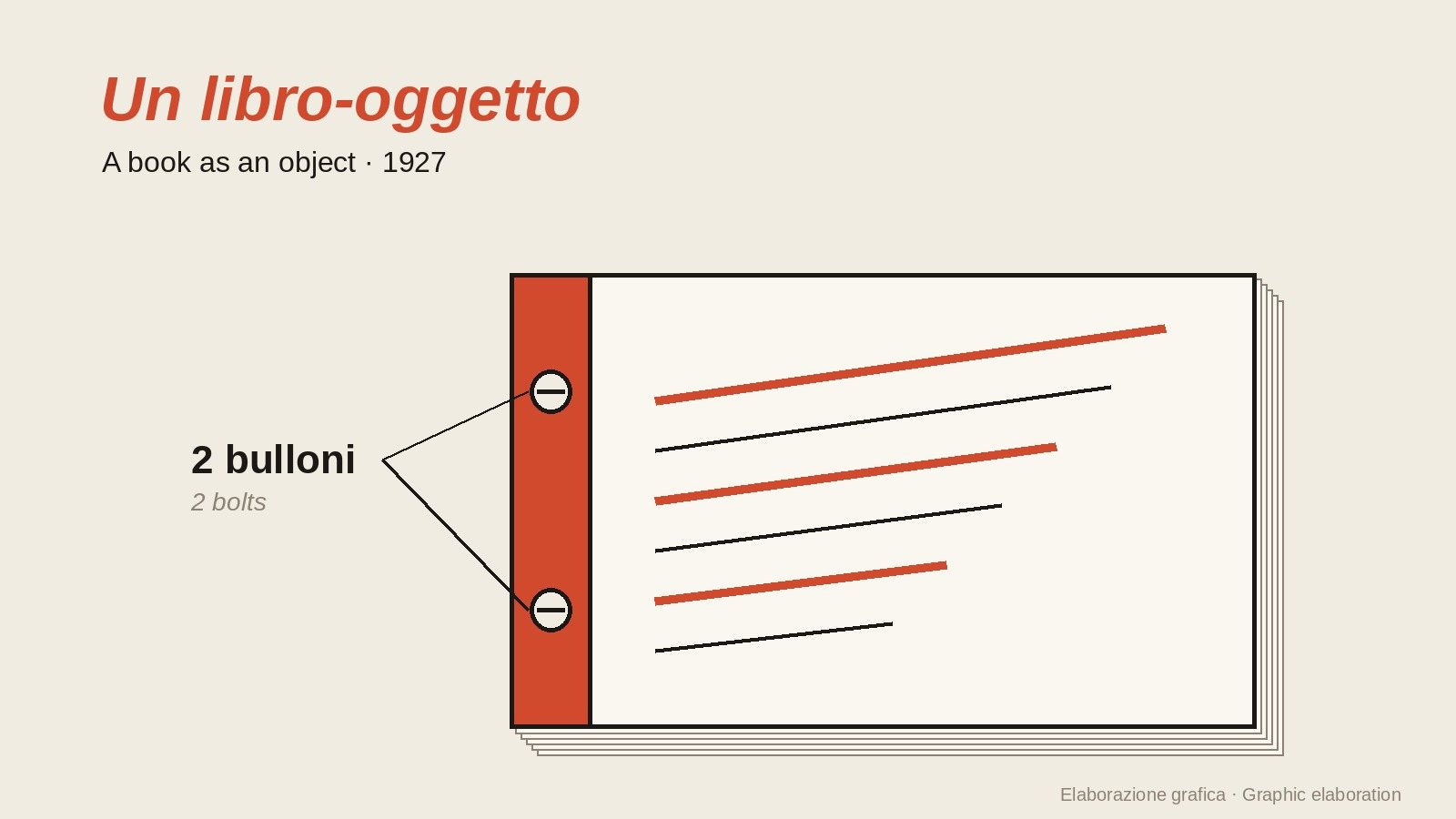
Un libro, di solito, si cuce o si incolla. Quello che Fortunato Depero pubblica nel 1927 è tenuto insieme da bulloni, come un pezzo di macchina. Il titolo è Depero futurista, ma tutti lo conoscono come il Libro imbullonato.
Non è un catalogo nel senso tradizionale. Depero vi raccoglie il lavoro dei suoi primi quindici anni: dipinti, progetti di architettura, costumi e scene per il teatro, arazzi, mobili, pubblicità. Ma non li mette in fila, pagina dopo pagina, come in una raccolta ordinata. Ogni pagina è costruita come una composizione a sé: le parole cambiano grandezza e direzione, salgono in diagonale, si dispongono a scalini o a raggiera, si mescolano alle immagini.
È il principio del paroliberismo futurista applicato all'impaginazione. La tipografia non si limita a trasportare un testo: diventa parte del messaggio, qualcosa da guardare oltre che da leggere. Chi sfoglia il volume non segue un racconto lineare, ma salta, torna indietro, gira il libro per leggere le righe storte.
Anche l'oggetto nel suo insieme comunica un'idea. I bulloni dichiarano che il libro è un prodotto moderno, costruito, quasi industriale, lontano dalla preziosità della rilegatura artigianale. È lo stesso spirito con cui Depero, negli stessi anni, lavora per Campari: la convinzione che un oggetto d'uso possa essere, allo stesso tempo, un'opera d'arte e uno strumento di comunicazione.
Il Libro imbullonato è diventato uno dei libri d'artista più celebri del Novecento. Quello esposto in questa sala è una copia anastatica, cioè una riproduzione fedele dell'originale.
English
A book is usually sewn or glued. The one Fortunato Depero published in 1927 is held together by bolts, like a piece of machinery. Its title is Depero futurista, but everyone knows it as the Bolted Book.
It is not a catalogue in the traditional sense. Depero gathers in it the work of his first fifteen years: paintings, architectural projects, costumes and sets for the theatre, tapestries, furniture, advertising. But he does not line them up page after page, as in an orderly collection. Each page is built as a composition in its own right: words change size and direction, climb diagonally, arrange themselves in steps or rays, mix with images.
It is the principle of Futurist "words in freedom" applied to page layout. Typography does not merely carry a text: it becomes part of the message, something to look at as well as to read. Whoever leafs through the volume does not follow a linear story, but jumps, goes back, turns the book around to read the crooked lines.
The object as a whole also conveys an idea. The bolts declare that the book is a modern product, constructed, almost industrial, far from the preciousness of hand binding. It is the same spirit in which Depero, in those same years, worked for Campari: the conviction that an everyday object can be, at the same time, a work of art and a means of communication.
The Bolted Book has become one of the most famous artist's books of the twentieth century. The one shown in this room is a facsimile edition, a faithful reproduction of the original.