
Velocità, parola, visione · Villa Casati Stampa
Il movimento
Linee-forza per tre stati d'animo · Force-lines for three states of mind — Elaborazione grafica
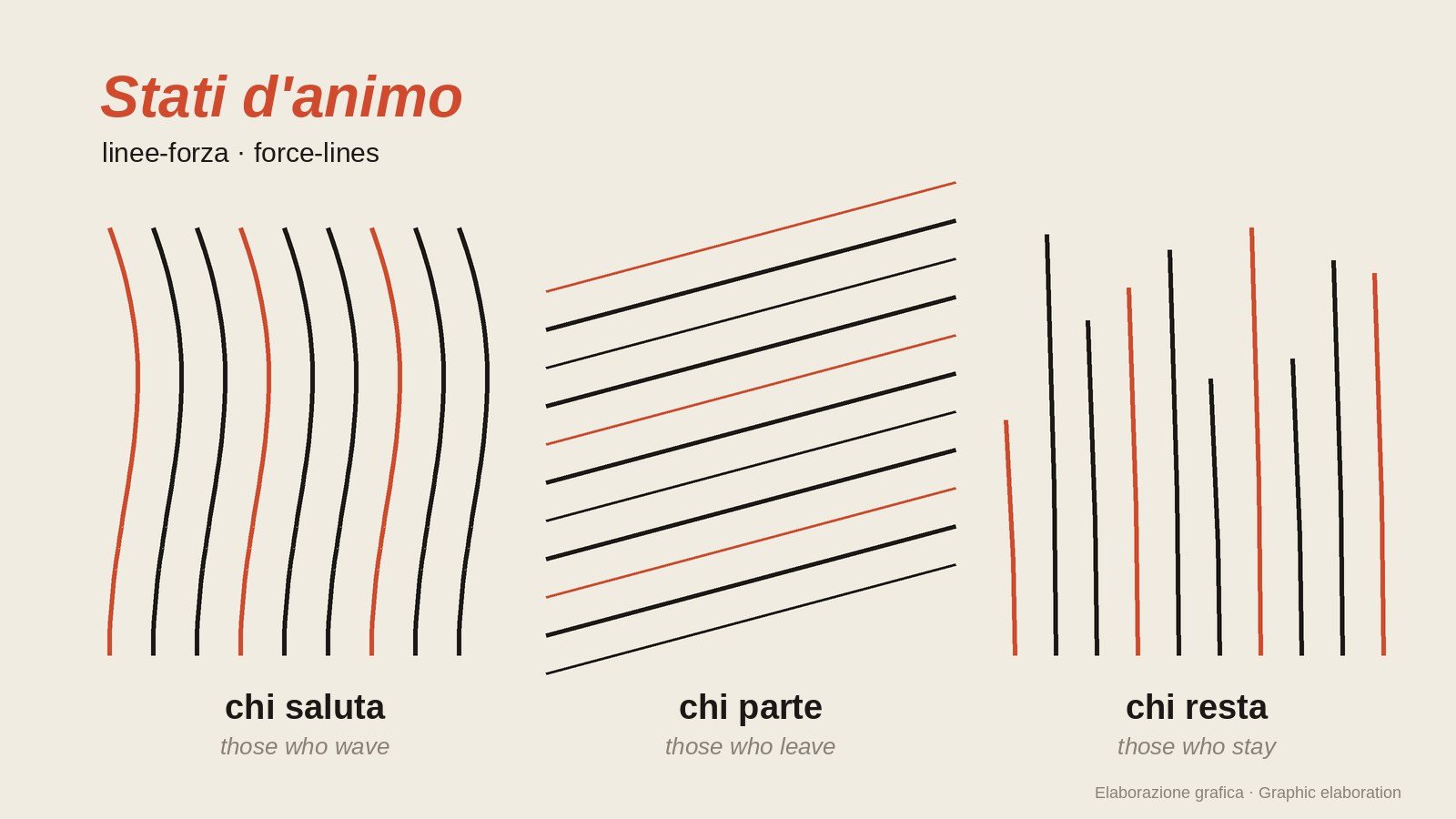
Un treno che parte si può descrivere in due modi. Si può dire quanto va veloce. Oppure si può raccontare che cosa succede a chi resta sulla banchina. I futuristi scelgono la seconda strada.
Nel 1910, con il manifesto tecnico della pittura, dichiarano che il movimento non si ferma in un'immagine: un cavallo in corsa, scrivono, «non ha quattro gambe: ne ha venti». Ciò che vediamo non è mai immobile, e il quadro deve restituire questa instabilità.
Boccioni va oltre. Per lui il movimento non è solo quello dei corpi, ma anche quello delle emozioni. Parla di «stati d'animo»: la stessa partenza è diversa per chi saluta, per chi si allontana, per chi rimane. Nei suoi quadri le linee cambiano andamento a seconda del sentimento: si piegano negli addii, si allungano e corrono con chi parte, ricadono pesanti su chi resta.
Nascono così parole nuove: «linee-forza», le direzioni lungo cui un oggetto sembra muoversi e agire sullo spazio intorno; «simultaneità», l'idea di mostrare nello stesso quadro ciò che si vede, ciò che si ricorda e ciò che si prova.
Lo stesso principio passa nella scultura. In Forme uniche della continuità nello spazio, del 1913, una figura avanza e il suo corpo si apre in onde e lame, come se l'aria ne portasse la forma. Oggi la si vede ogni giorno, senza farci caso: è sulla moneta italiana da 20 centesimi.
In questa sala il movimento si sente, prima ancora di vederlo. Più avanti, nella sala di Balla, diventerà soprattutto immagine, tempo e luce.
English
A departing train can be described in two ways. One can say how fast it goes. Or one can tell what happens to those left on the platform. The Futurists choose the second way.
In 1910, in the technical manifesto of painting, they declare that movement cannot be frozen in a single image: a running horse, they write, "has not four legs, but twenty". Nothing we see is ever still, and a painting must convey that instability.
Boccioni goes further. For him movement is not only that of bodies, but also that of emotions. He speaks of "states of mind": the same departure is different for those who wave, those who move away, those who stay. In his paintings lines change with the feeling: they bend in farewells, stretch and race with those who leave, fall heavily on those who remain.
New words are born: "force-lines", the directions along which an object seems to move and act on the space around it; "simultaneity", the idea of showing in one picture what we see, what we remember and what we feel.
The same principle enters sculpture. In Unique Forms of Continuity in Space, from 1913, a figure strides forward and its body opens into waves and blades, as if shaped by the air. We see it every day without noticing: it is on the Italian 20-cent coin.
In this room movement is felt before it is seen. Further on, in Balla's room, it will become above all image, time and light.