
Velocità, parola, visione · Villa Casati Stampa
Il volantino
«Fondazione e Manifesto del Futurismo», volantino, Milano, 1909 · Leaflet, Milan, 1909
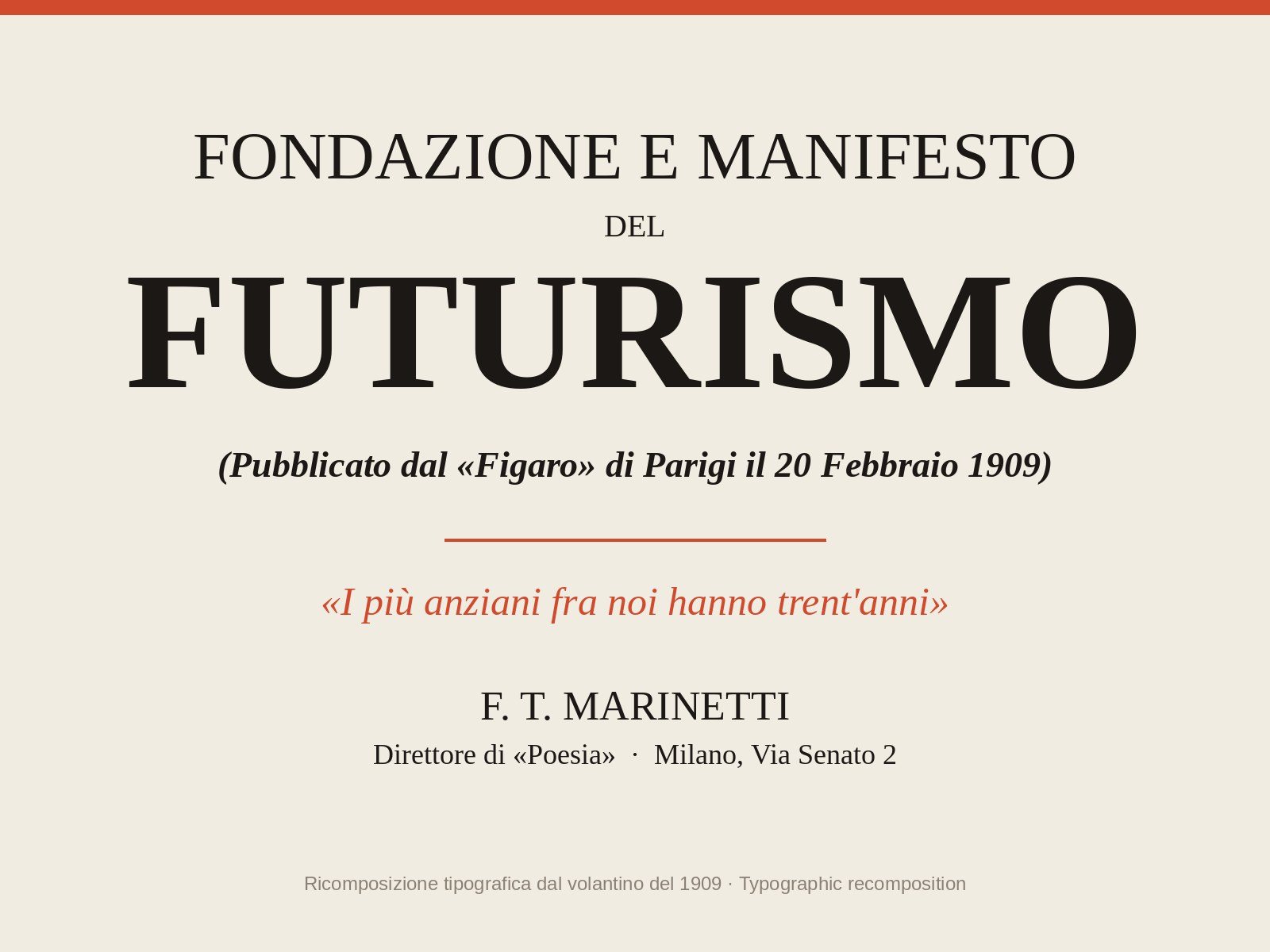
Un foglio piegato in due, quattro pagine, nessuna copertina. Sotto il titolo, una riga tra parentesi: «Pubblicato dal Figaro di Parigi il 20 febbraio 1909». Il manifesto si presenta ai lettori italiani con una credenziale straniera.
Il testo è quello uscito sul giornale parigino: il racconto della notte e dell’automobile finita nel fossato, gli undici punti, la chiusura. Ma l’oggetto è un altro. Il giornale si legge e si getta; questo foglio si conserva, passa di mano in mano, si spedisce per posta. È fatto per circolare.
In fondo all’ultima pagina c’è la firma: «F. T. Marinetti, Direttore di Poesia», con l’indirizzo, Milano, via Senato 2. Più sotto, in piccolo, il nome della tipografia. Nessun editore esterno: il foglio esce dalla stessa casa che pubblica la rivista. Marinetti è autore, editore e distributore di sé stesso, e l’indirizzo stampato in calce è un invito a scrivere, a rispondere, ad aderire.
È il metodo che accompagnerà tutto il movimento. Ogni nuovo manifesto sarà stampato come volantino e inviato a giornali, scrittori, artisti, critici, amici e avversari. Il Futurismo si diffonde anche così, per posta, un foglio alla volta.
Nel testo compare una frase rivelatrice: «I più anziani fra noi hanno trent’anni». Marinetti, che la firma, ne ha già trentadue. Fin dall’inizio il Futurismo è anche costruzione di un’immagine.
Pure questo esemplare ha una storia. Il timbro rosso sulla prima pagina indica che è appartenuto alla biblioteca di Gaetano Rossitto, prima di arrivare alla Biblioteca Universitaria di Padova. Un foglio pensato per durare pochi giorni ha attraversato più di un secolo.
English
“Foundation and Manifesto of Futurism”, leaflet, Milan, 1909
A sheet folded in two, four pages, no cover. Beneath the title, a line in brackets: “Published by the Figaro of Paris on 20 February 1909”. The manifesto introduces itself to Italian readers with a foreign credential.
The text is the one printed in the Parisian paper: the story of the night and of the car ending up in the ditch, the eleven points, the closing section. But the object is different. A newspaper is read and thrown away; this sheet is kept, passed from hand to hand, sent by post. It is made to circulate.
At the foot of the last page is the signature: “F. T. Marinetti, Editor of Poesia”, with the address, Milan, Via Senato 2. Below, in small print, the name of the printer. No outside publisher: the leaflet comes from the same house that publishes the magazine. Marinetti is his own author, publisher and distributor, and the address printed at the bottom is an invitation to write, to reply, to join.
This is the method that will accompany the whole movement. Each new manifesto will be printed as a leaflet and sent to newspapers, writers, artists, critics, friends and opponents. Futurism spreads this way too, by post, one sheet at a time.
One sentence in the text is revealing: “The oldest among us are thirty”. Marinetti, who signs it, is already thirty-two. From the very beginning, Futurism is also the construction of an image.
This copy has a story of its own. The red stamp on the first page shows that it belonged to the library of Gaetano Rossitto before reaching the University Library of Padua. A sheet meant to last a few days has crossed more than a century.
È lo stesso inconveniente capitato alla pagina «Il movimento»: con testi lunghi il campo di Wix a volte si tronca all’incollaggio. Dopo averlo rimesso, riapri la pagina dal telefono e controlla che finisca con «ha attraversato più di un secolo», altrimenti conviene incollare in due passaggi, prima l’italiano e poi l’inglese.