
Velocità, parola, visione · Villa Casati Stampa
La banchina
Una stazione evocata, Milano 1911 · An evoked station, Milan 1911 — Elaborazione grafica
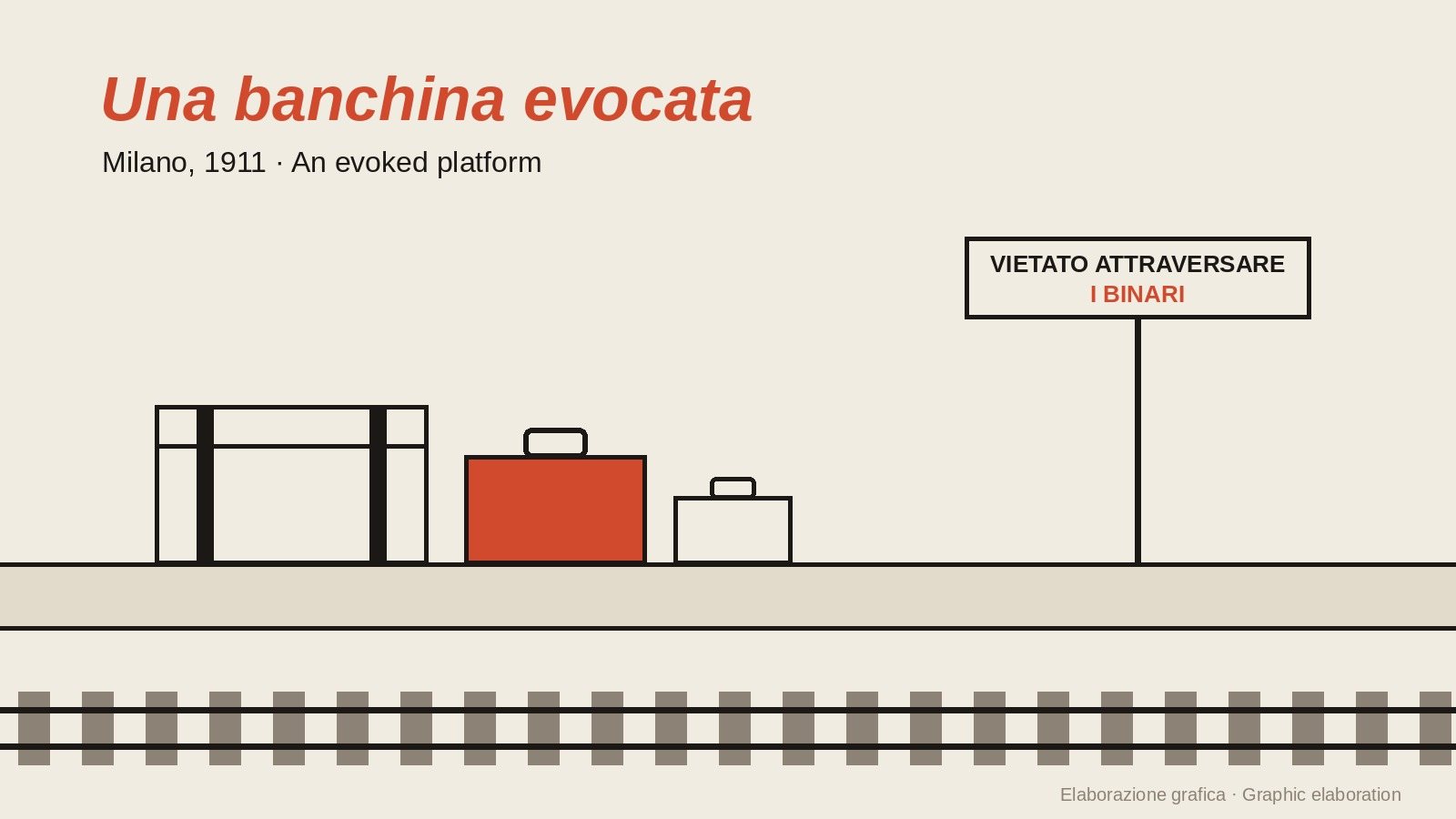
Un tratto di binario, qualche valigia, un baule, cartelli con divieti e avvertenze. Non è una stazione vera: è una banchina evocata, costruita con pochi elementi per suggerire un luogo e un momento.
Il luogo è la stazione di Milano come poteva essere intorno al 1911. Non la Stazione Centrale che conosciamo oggi, inaugurata solo nel 1931, ma quella precedente, più piccola, già insufficiente per il traffico di una città in crescita. La prima pietra della nuova era stata posata nel 1906: la Milano dei futuristi è una città in cantiere, che cambia sotto i loro occhi.
Non abbiamo trovato fotografie di quella banchina che permettano di ricostruirla con esattezza. Per questo abbiamo scelto di non fingere. Gli oggetti che vedete sono d'epoca o del tipo di quelli usati allora, ma non provengono da Milano Centrale: servono a evocare un'atmosfera, non a documentare un luogo preciso.
L'atmosfera è quella che interessa a Boccioni. Nei suoi quadri la stazione non è un edificio, ma il punto in cui le vite si separano: il fumo, il rumore, gli abbracci, la folla che si muove in direzioni opposte. La modernità, qui, ha un volto preciso: quello di chi parte e di chi resta.
Fermatevi un momento sulla banchina. È il luogo in cui il movimento, prima di essere velocità, è un'emozione.
English
A stretch of track, a few suitcases, a trunk, signs with warnings and prohibitions. This is not a real station: it is an evoked platform, built from a few elements to suggest a place and a moment.
The place is Milan's station as it might have been around 1911. Not the Central Station we know today, opened only in 1931, but the earlier one, smaller and already too small for the traffic of a growing city. The first stone of the new one had been laid in 1906: the Futurists' Milan is a city under construction, changing before their eyes.
We found no photographs of that platform that would allow an exact reconstruction. So we chose not to pretend. The objects you see are period pieces or of the kind used at the time, but they do not come from Milano Centrale: they are here to evoke an atmosphere, not to document a specific place.
That atmosphere is what interests Boccioni. In his paintings the station is not a building but the point where lives part: smoke, noise, embraces, the crowd moving in opposite directions. Modernity here has a precise face: that of those who leave and those who stay.
Pause for a moment on the platform. It is the place where movement, before being speed, is an emotion.