
Velocità, parola, visione · Villa Casati Stampa
L'auto è passata
Giacomo Balla, Velocità astratta – L'auto è passata, 1913 · Abstract Speed – The Car has Passed — Elaborazione grafica
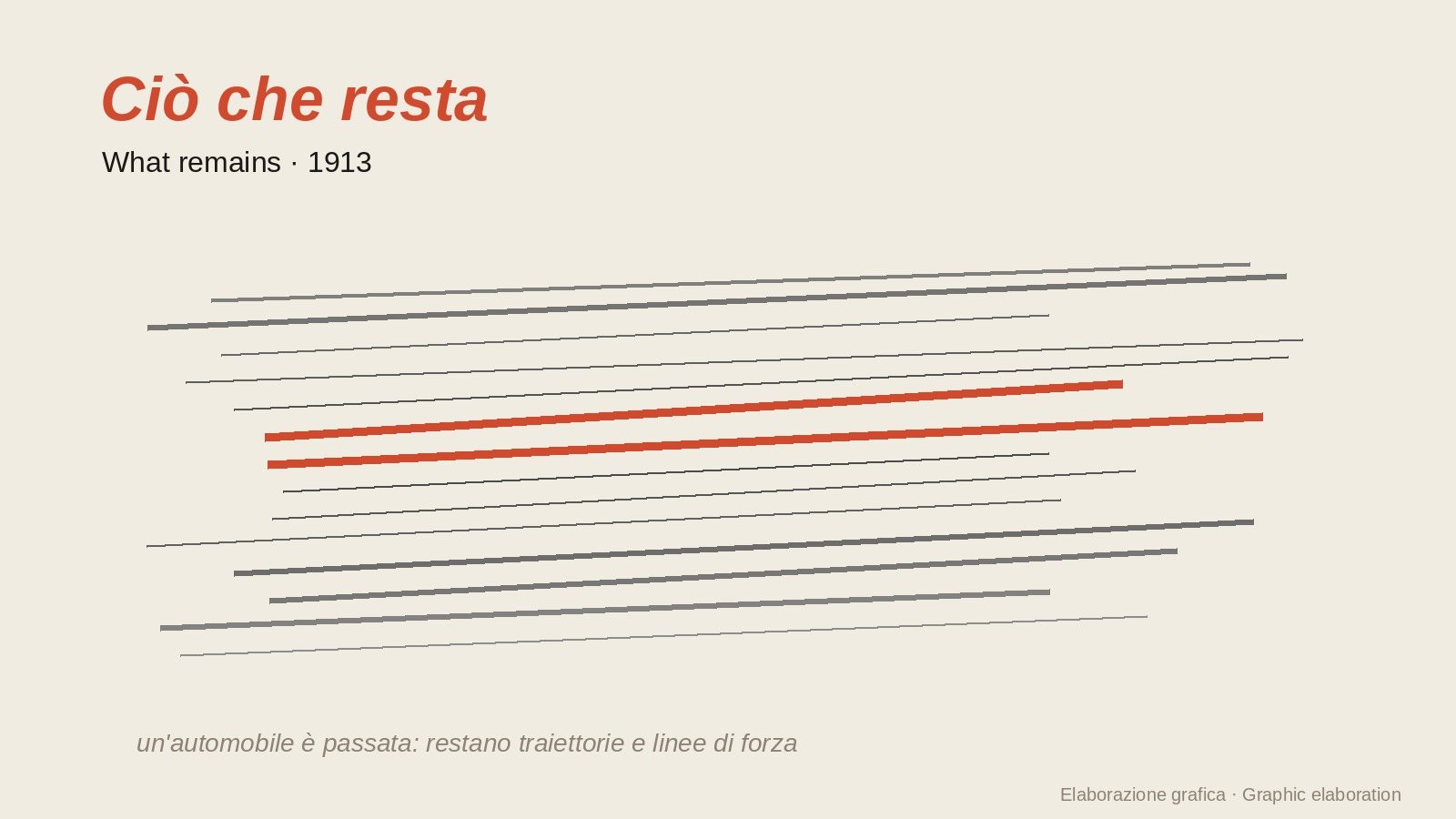
Il titolo dice già tutto: l'auto è passata. Nel quadro non c'è nessuna automobile. C'è soltanto quello che resta dopo il suo passaggio: linee che tagliano lo spazio, direzioni, vibrazioni dell'aria e della luce. Balla dipinge il 1913 così, attraverso le tracce della velocità più che la velocità stessa.
In quegli anni l'automobile è il simbolo della modernità. Il Manifesto del Futurismo, nel 1909, la mette al centro del suo elogio della velocità. Balla però non dipinge un'automobile da ammirare. La osserva sfrecciare lungo le strade e si chiede che cosa accade allo sguardo quando qualcosa passa troppo in fretta per essere visto.
Tra il 1912 e il 1914 dedica a questo tema una lunga serie di studi e dipinti. Il procedimento è quello già visto nella fascia di Marey, portato alle estreme conseguenze. Prima il movimento si scompone in fasi. Poi le fasi si fondono. Infine il soggetto si dissolve, e restano solo le linee di forza, cioè le direzioni lungo cui la velocità ha agito sullo spazio.
Il risultato è una delle prime pitture del Novecento vicine all'astrazione. Ma non nasce da un rifiuto della realtà: nasce, al contrario, dall'osservazione attentissima di un'esperienza nuova e quotidiana, quella di un mezzo che attraversa il paesaggio e lo trasforma in un lampo.
Nella sala di Boccioni il movimento si sentiva, come un'emozione. Qui si guarda: le poltrone sono rivolte verso l'opera proprio per invitare a fermarsi davanti a ciò che dura meno di un istante.
L'originale fa parte della collezione della Tate di Londra. Quella esposta in questa sala è una riproduzione materica realizzata per la mostra.
English
The title says it all: the car has passed. There is no car in the painting. There is only what remains after it has gone by: lines cutting through space, directions, vibrations of air and light. In 1913 Balla painted speed in this way, through its traces rather than speed itself.
In those years the car was the symbol of modernity. The Manifesto of Futurism, in 1909, placed it at the centre of its praise of speed. Balla, however, did not paint a car to be admired. He watched cars race along the roads and asked what happens to our sight when something passes too quickly to be seen.
Between 1912 and 1914 he devoted a long series of studies and paintings to this theme. The process is the one already seen in Marey's band, taken to its extreme. First movement is broken into phases. Then the phases merge. Finally the subject dissolves, leaving only the lines of force, the directions along which speed has acted on space.
The result is one of the first twentieth-century paintings close to abstraction. Yet it does not come from a rejection of reality: on the contrary, it comes from the close observation of a new, everyday experience, that of a vehicle crossing the landscape and turning it into a flash.
In Boccioni's room movement was felt, like an emotion. Here it is looked at: the armchairs face the work precisely to invite visitors to pause before something that lasts less than an instant.
The original belongs to the Tate collection in London. The one shown in this room is a material reproduction made for the exhibition.