
Velocità, parola, visione · Villa Casati Stampa
Luce e colore
Giacomo Balla, Compenetrazioni iridescenti, 1912–1914 · Iridescent Interpenetrations — Elaborazione grafica
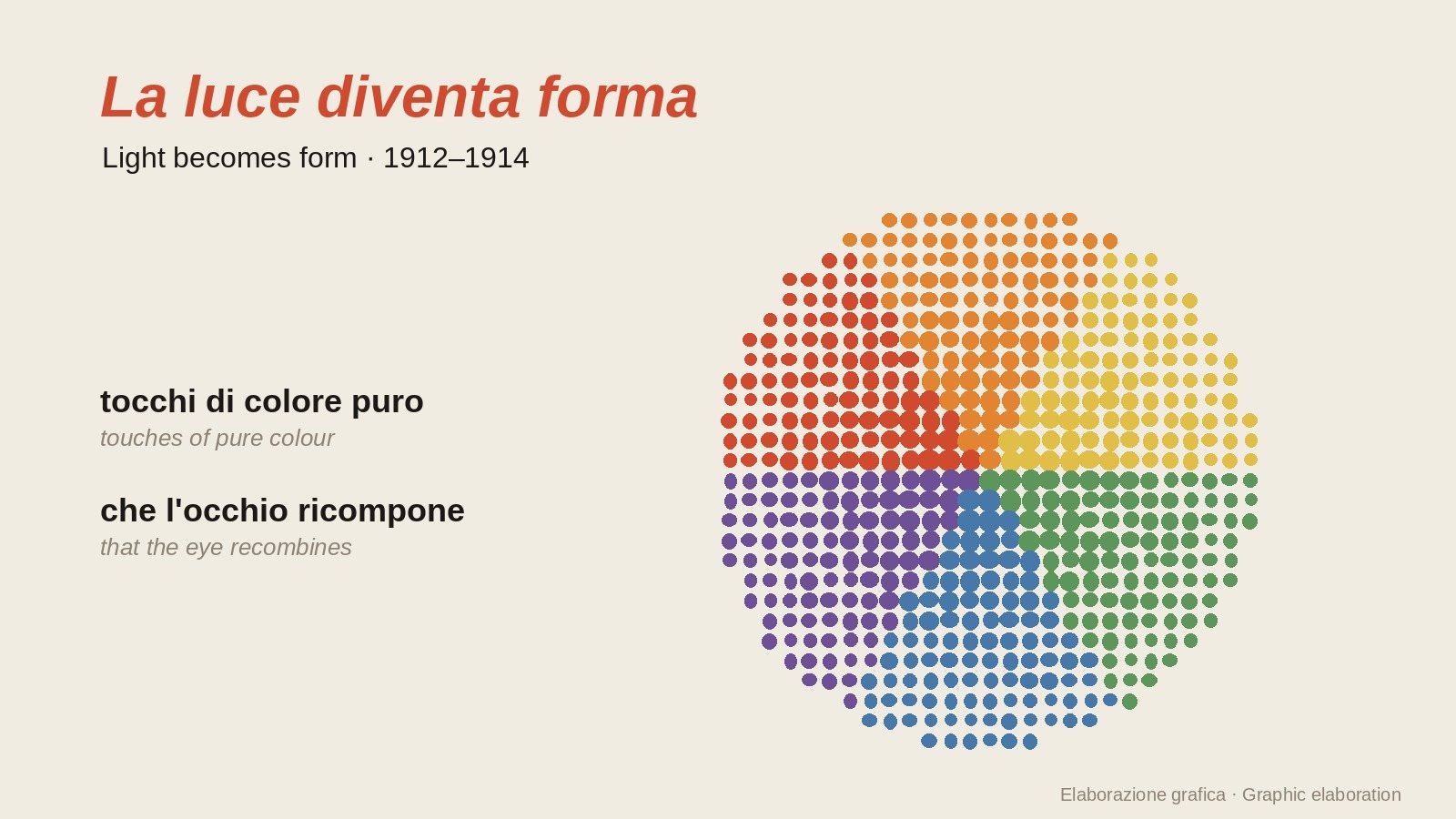
Prima di dipingere il movimento, Balla ha dipinto la luce. Da pittore divisionista scompone i colori in piccoli tocchi puri, accostati sulla tela, che l'occhio ricompone guardando. È una pittura che si interroga su come vediamo, prima ancora che su che cosa vediamo.
Tra il 1912 e il 1914 questa ricerca arriva a un punto estremo. Balla realizza una serie di studi e dipinti che chiama Compenetrazioni iridescenti. Non vi compare alcun oggetto riconoscibile: solo triangoli, rombi e fasce di colore che si incastrano e si sovrappongono, digradando da una tinta all'altra. Sembrano schemi di come la luce si rifrange, si scompone e si ricompone, come attraverso un prisma.
Secondo gli studi, le prime nascono durante un soggiorno in Germania, a Düsseldorf, e Balla le sviluppa in molte varianti, spesso su piccoli fogli. Sono tra le prime opere interamente astratte realizzate da un artista italiano. Eppure, anche qui, non c'è un rifiuto della realtà: c'è il tentativo di dare forma a qualcosa di reale ma invisibile, la struttura stessa della luce e del colore.
In questa sala non è esposta una Compenetrazione. Abbiamo scelto di raccontarla qui perché è il terzo passo del percorso di Balla che la sala ricostruisce. Prima il movimento si scompone, come nella fascia di Marey. Poi il soggetto si dissolve e restano le linee di forza, come in L'auto è passata. Infine luce e colore diventano autonomi, e non hanno più bisogno di un oggetto da descrivere.
Da qui a portare il colore fuori dal quadro, negli oggetti e negli ambienti, il passo è breve. È quello che Balla dichiarerà nel 1915, insieme a Depero, nella Ricostruzione futurista dell'universo.
English
Before painting movement, Balla painted light. As a Divisionist painter he broke colours into small pure touches, placed side by side on the canvas, which the eye recombines as it looks. It is a painting that asks how we see, even before what we see.
Between 1912 and 1914 this research reached an extreme point. Balla produced a series of studies and paintings he called Iridescent Interpenetrations. No recognisable object appears in them: only triangles, lozenges and bands of colour that interlock and overlap, shading from one hue to the next. They look like diagrams of how light is refracted, broken down and recombined, as if through a prism.
According to scholars, the first ones were made during a stay in Germany, in Düsseldorf, and Balla developed them in many variations, often on small sheets. They are among the first entirely abstract works made by an Italian artist. Yet here too there is no rejection of reality: there is an attempt to give form to something real but invisible, the very structure of light and colour.
No Interpenetration is on display in this room. We chose to describe it here because it is the third step in the path of Balla's work that the room retraces. First movement is broken down, as in Marey's band. Then the subject dissolves and only the lines of force remain, as in The Car has Passed. Finally light and colour become autonomous, no longer needing an object to describe.
From here, taking colour out of the painting and into objects and spaces is a short step. It is what Balla would declare in 1915, together with Depero, in the Futurist Reconstruction of the Universe.