
Velocità, parola, visione · Villa Casati Stampa
Mafarka il futurista
F. T. Marinetti, Mafarka il futurista, Edizioni futuriste di «Poesia», Milano, 1910 · Milan, 1910
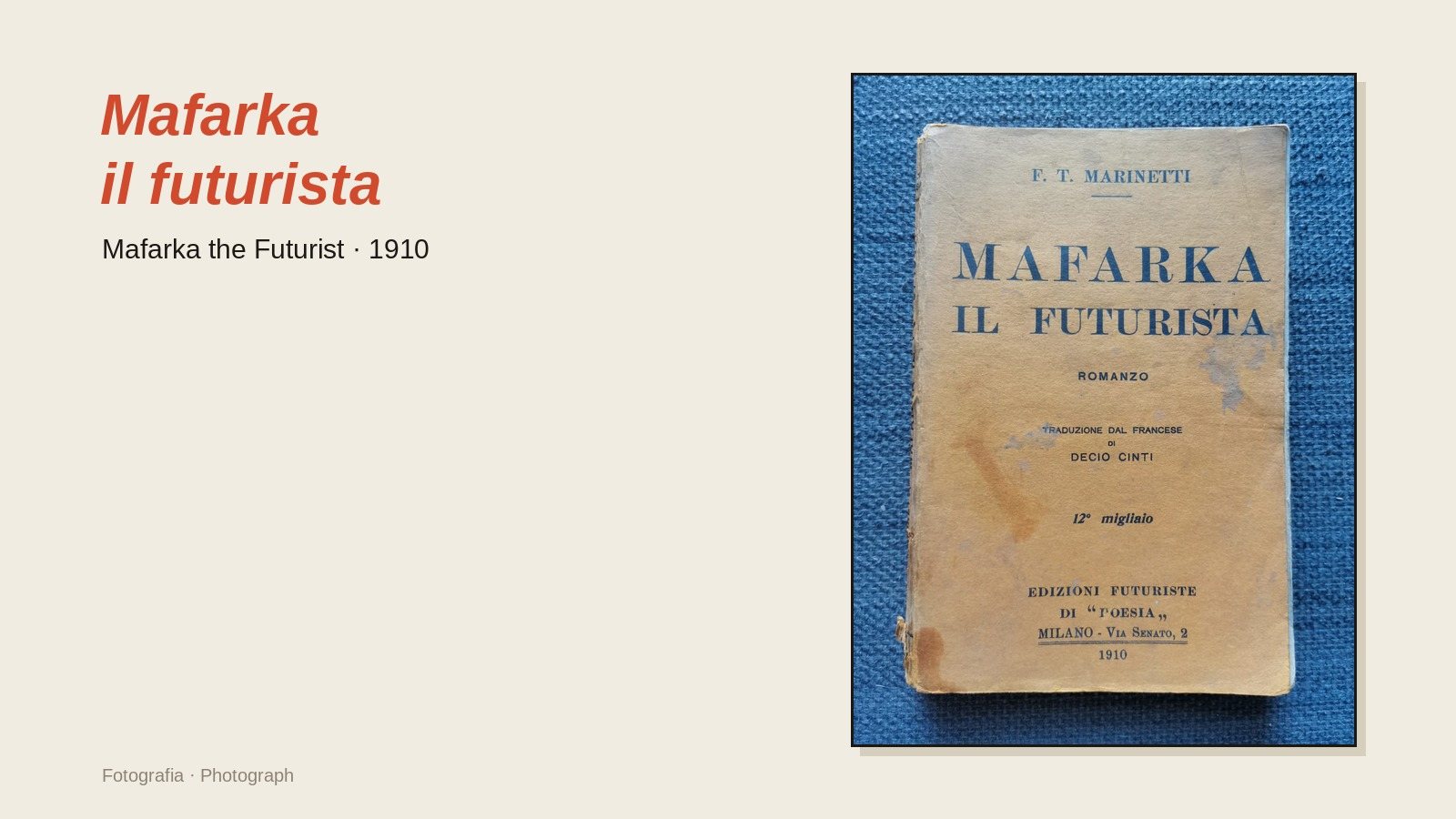
Sulla copertina, sotto il titolo, due indicazioni: «Traduzione dal francese di Decio Cinti» e, in corsivo, «12° migliaio». Raccontano come Marinetti costruisce un libro, prima ancora del romanzo che contiene.
Mafarka esce prima in francese, a Parigi. L'edizione italiana arriva nel 1910, pubblicata dalle Edizioni futuriste di «Poesia», la casa editrice nata attorno alla rivista di Marinetti, con lo stesso indirizzo di via Senato 2. Il movimento non aspetta gli editori: li sostituisce.
«12° migliaio» significa dodicimila copie. È un dato da prendere con cautela: annunciare tirature alte era anche un modo per presentare il libro come un caso editoriale. Ma il gesto è rivelatore. La copertina non presenta soltanto un'opera: ne pubblicizza il successo.
L'attenzione arriva comunque, e per un'altra via. Nel 1910 il romanzo viene sequestrato e Marinetti è processato a Milano per oltraggio al pudore. Il processo diventa un evento pubblico, seguito dalla stampa. Assolto in primo grado, sarà condannato in appello. Ancora una volta lo scandalo lavora per la diffusione.
Il libro però non è soltanto un caso giudiziario. È ambientato in un'Africa immaginaria e il suo protagonista, un condottiero, arriva a generare da solo, senza donna, un figlio alato e meccanico. Violenza, disprezzo della figura femminile, un immaginario coloniale: sono temi che il Futurismo rivendica e che oggi leggiamo come parte dei suoi limiti, non del suo fascino.
Questa copia tiene insieme due storie: quella di un'avanguardia che sa usare l'editoria e la cronaca giudiziaria, e quella delle idee che quella macchina comunicativa ha messo in circolazione.
English
On the cover, beneath the title, two notes: "Translated from the French by Decio Cinti" and, in italics, "12th thousand". They tell us how Marinetti builds a book, even before the novel it contains.
Mafarka first appears in French, in Paris. The Italian edition follows in 1910, published by the Edizioni futuriste di "Poesia", the publishing house that grew out of Marinetti's magazine, at the same address in Via Senato 2. The movement does not wait for publishers: it replaces them.
"12th thousand" means twelve thousand copies. The figure should be taken with caution: announcing large print runs was also a way of presenting a book as a publishing phenomenon. But the gesture is telling. The cover does not merely present a work: it advertises its success.
Attention comes anyway, by another route. In 1910 the novel is seized and Marinetti is tried in Milan for offending public decency. The trial becomes a public event, followed by the press. Acquitted at first instance, he will be convicted on appeal. Once again scandal works in favour of circulation.
Yet the book is not just a court case. It is set in an imaginary Africa, and its hero, a warlord, ends up generating on his own, without a woman, a winged mechanical son. Violence, contempt for women, a colonial imagination: these are themes Futurism proudly claims, and which today we read as part of its limits, not of its appeal.
This copy holds two stories together: that of an avant-garde able to use publishing and court reporting, and that of the ideas that this communication machine set in circulation.