
Velocità, parola, visione · Villa Casati Stampa
Messaggio e Manifesto
Dal Messaggio al Manifesto dell'architettura futurista, 1914 · From Message to Manifesto, 1914 — Elaborazione grafica
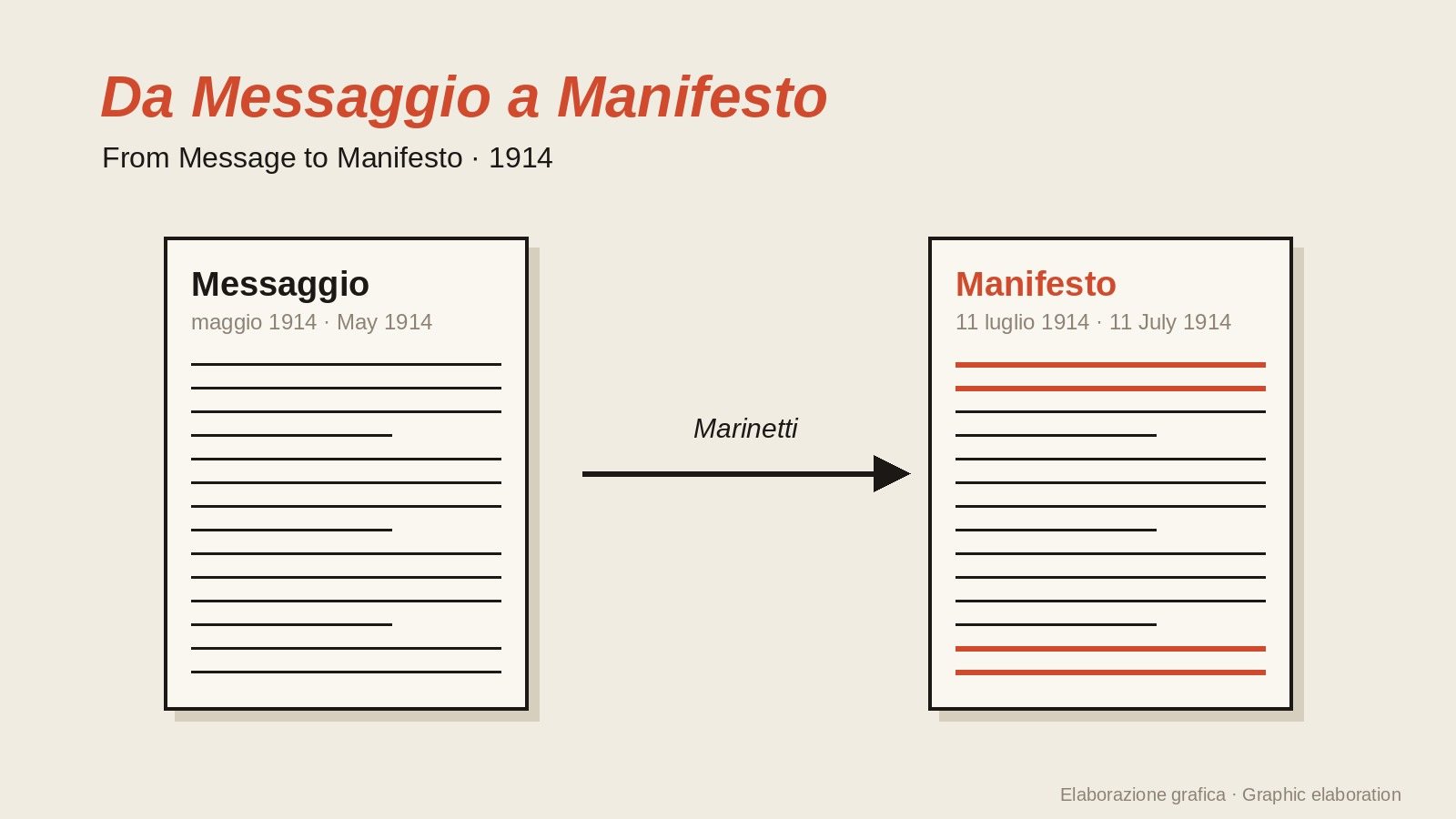
Il testo più famoso di Sant'Elia esiste in due versioni, a distanza di poche settimane. Confrontarle aiuta a capire che cosa succede quando un'idea incontra il Futurismo.
La prima è il Messaggio. Esce nel maggio 1914 nel catalogo della mostra del gruppo Nuove Tendenze, accanto ai disegni della Città Nuova. È il testo di un architetto che riflette sulla città moderna: i nuovi materiali, il cemento armato e il ferro, la necessità di edifici pensati per la vita contemporanea anziché copiati dagli stili del passato.
La seconda è il Manifesto dell'architettura futurista, datato 11 luglio 1914, stampato come volantino e pubblicato il 1° agosto sulla rivista Lacerba. La parte centrale riprende quasi per intero il Messaggio. L'inizio e la fine invece sono nuovi, scritti con il tono acceso e polemico dei manifesti futuristi, e secondo gli studi difficilmente sono di Sant'Elia.
L'intervento di Marinetti, aiutato dal segretario Decio Cinti, è documentato e non marginale. Tra le idee aggiunte c'è quella di una casa destinata a durare meno di chi la abita, perché ogni generazione dovrebbe costruirsi la propria città. Alcuni studiosi ritengono che Sant'Elia non la condividesse, pur senza chiederne la rimozione. Altri pensano che alla stesura abbiano contribuito più mani. Il dibattito sulla paternità del testo resta aperto.
Il risultato è un documento a due voci. Il Futurismo ottiene finalmente un manifesto sull'architettura, che fino ad allora mancava. Sant'Elia trova un palcoscenico per le sue idee, ma dentro una cornice che non ha scelto del tutto.
Per questo, guardando i disegni esposti, vale la pena notare una tensione. Il Manifesto parla di un'architettura leggera, mobile, provvisoria; le tavole mostrano spesso volumi massicci e monumentali. È anche per questo che in mostra parliamo di Sant'Elia come architetto associato al Futurismo.
English
Sant'Elia's best-known text exists in two versions, a few weeks apart. Comparing them helps us understand what happens when an idea meets Futurism.
The first is the Message. It appeared in May 1914 in the catalogue of the Nuove Tendenze group's exhibition, alongside the drawings of the New City. It is the text of an architect reflecting on the modern city: new materials such as reinforced concrete and iron, the need for buildings designed for contemporary life rather than copied from past styles.
The second is the Manifesto of Futurist Architecture, dated 11 July 1914, printed as a leaflet and published on 1 August in the magazine Lacerba. Its central section repeats the Message almost in full. The opening and the ending, however, are new, written in the fiery, polemical tone of Futurist manifestos, and according to scholars they are unlikely to be by Sant'Elia.
Marinetti's intervention, helped by his secretary Decio Cinti, is documented and substantial. Among the ideas added is that of a house meant to last less than those who live in it, since each generation should build its own city. Some scholars believe Sant'Elia did not share it, though he did not ask for it to be removed. Others think several hands contributed to the text. The debate over its authorship remains open.
The result is a document with two voices. Futurism finally gains a manifesto on architecture, which it had lacked until then. Sant'Elia gains a stage for his ideas, but within a frame he did not entirely choose.
That is why, looking at the drawings on display, it is worth noticing a tension. The Manifesto speaks of an architecture that is light, mobile, temporary; the drawings often show massive, monumental volumes. This is also why in this exhibition we speak of Sant'Elia as an architect associated with Futurism.