
Velocità, parola, visione · Villa Casati Stampa
Omaggio a Blériot
Il volo del 25 luglio 1909 · The flight of 25 July 1909 — Elaborazione grafica
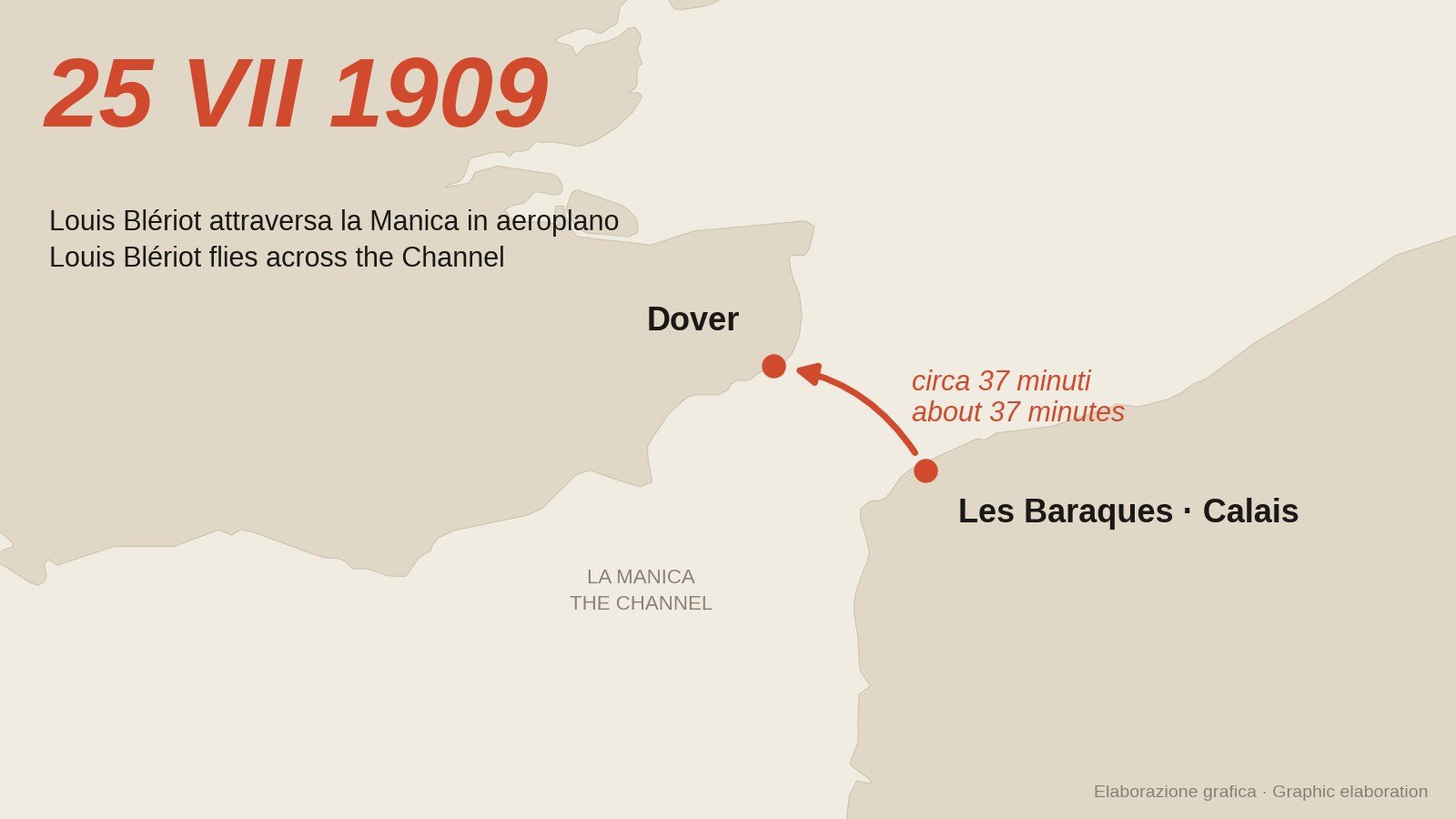
Il 25 luglio 1909 Louis Blériot decolla da Les Baraques, vicino a Calais, e circa trentasette minuti dopo atterra presso Dover. È la prima traversata della Manica in aeroplano. Succede nello stesso anno del Manifesto del Futurismo: il cielo comincia a sembrare una nuova strada.
Cinque anni dopo il pittore francese Robert Delaunay dedica a quell'impresa un quadro monumentale, di due metri e mezzo per lato. Non racconta il volo come una cronaca: lo trasforma in dischi e contrasti di colore che ruotano, si sovrappongono e vibrano. Tra le forme circolari emergono il sole, una grande elica, alcuni aeroplani e la Torre Eiffel, simboli di una modernità che mette in movimento anche la pittura.
Delaunay non è un futurista. Lavora a Parigi, e la sua ricerca viene associata all'orfismo, un nome coniato dal poeta Guillaume Apollinaire. Ma si pone le stesse domande: come rappresentare un mondo trasformato dalla velocità, come riunire in una sola immagine percezioni diverse e simultanee.
Per Delaunay la simultaneità nasce soprattutto dal colore: tinte accostate che sembrano intensificarsi e muoversi a vicenda. I futuristi usano la stessa parola in un senso più ampio, per la compresenza di movimenti, tempi e punti di vista. Tra i due ambienti nasce una polemica su chi sia arrivato prima. Più che una disputa, è il segno che a Parigi come a Milano molti artisti cercano risposte a una nuova esperienza del mondo.
Per questo il quadro è qui, accanto al treno. Il treno ha accorciato le distanze sulla terra; l'aeroplano promette di superarle attraverso il cielo. E Calais, punto di partenza di Blériot, compare anche nell'orario ferroviario di questa sala.
Quella che vedete è una riproduzione materica in formato ridotto, realizzata per restituire anche il rilievo della superficie pittorica. L'originale è conservato al Kunstmuseum di Basilea, in Svizzera.
English
On 25 July 1909 Louis Blériot takes off from Les Baraques, near Calais, and about thirty-seven minutes later lands near Dover. It is the first crossing of the Channel by aeroplane. It happens in the same year as the Manifesto of Futurism: the sky begins to look like a new road.
Five years later the French painter Robert Delaunay devotes to that feat a monumental painting, two and a half metres on each side. He does not tell the flight as a chronicle: he turns it into discs and contrasts of colour that spin, overlap and vibrate. Among the circular forms appear the sun, a large propeller, several aeroplanes and the Eiffel Tower, symbols of a modernity that sets painting itself in motion.
Delaunay is not a Futurist. He works in Paris, and his research is associated with Orphism, a name coined by the poet Guillaume Apollinaire. Yet he asks the same questions: how to depict a world transformed by speed, how to bring together in one image different, simultaneous perceptions.
For Delaunay simultaneity comes above all from colour: adjacent hues that seem to intensify and set each other in motion. The Futurists use the same word in a broader sense, for the coexistence of movements, times and points of view. A dispute arises between the two circles over who came first. More than a quarrel, it shows that in Paris as in Milan many artists were seeking answers to a new experience of the world.
That is why the painting is here, beside the train. The train shortened distances on land; the aeroplane promised to overcome them through the sky. And Calais, Blériot's starting point, also appears in the railway timetable in this room.
What you see is a reduced-scale material reproduction, made to render the relief of the painted surface as well. The original is in the Kunstmuseum Basel, Switzerland.