
Velocità, parola, visione · Villa Casati Stampa
Sant'Elia
Antonio Sant'Elia, 1888–1916 — Elaborazione grafica
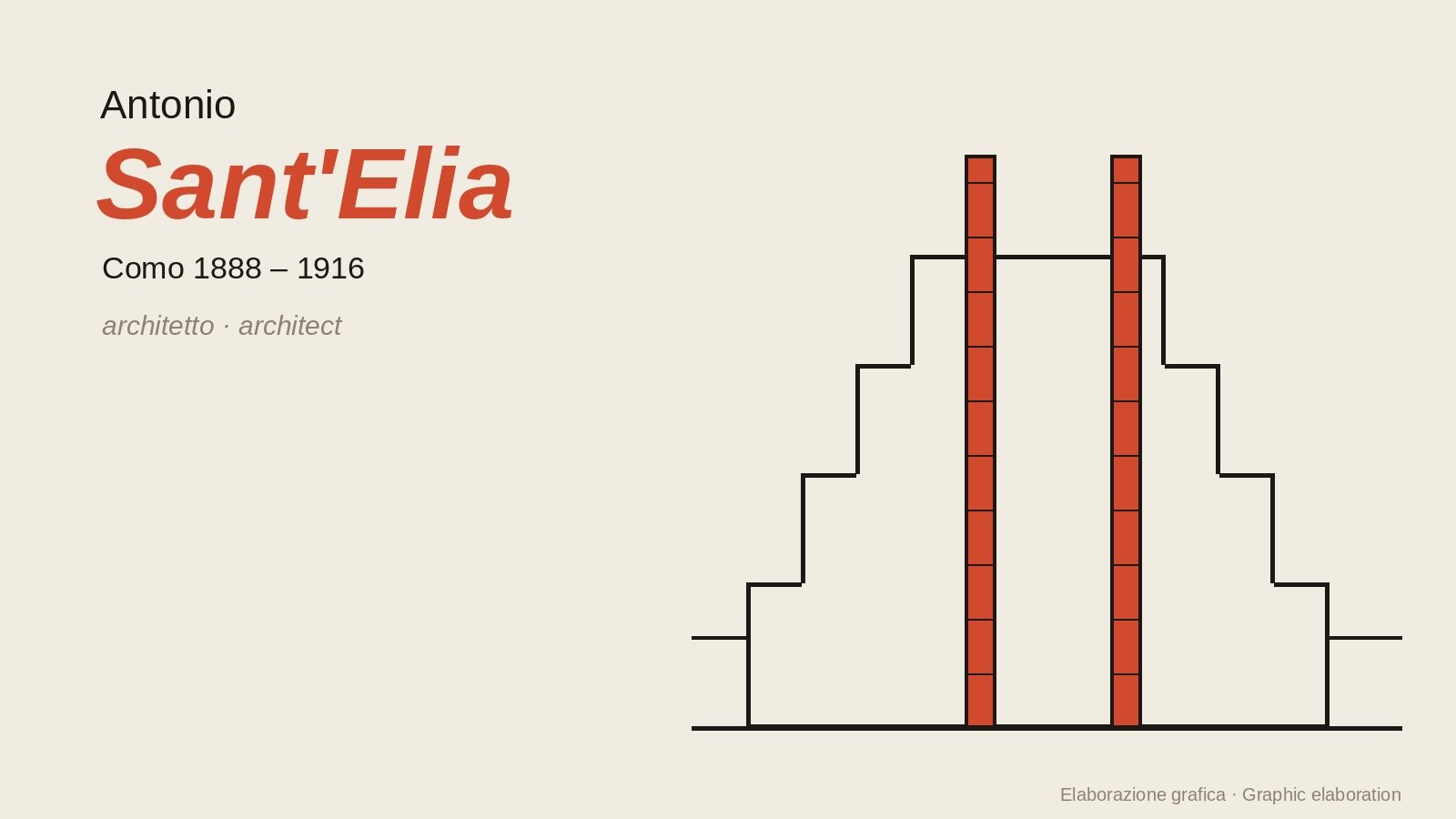
A ventisei anni Antonio Sant'Elia ha già disegnato una città intera. Non l'ha costruita, e non la costruirà mai: esiste solo sulla carta, in fogli di piccolo formato tracciati a matita e a inchiostro. Eppure quei disegni sono diventati l'immagine stessa della città futurista.
È nato a Como nel 1888. Si diploma come capomastro, a diciannove anni si trasferisce a Milano, lavora come disegnatore in un ufficio tecnico e segue i corsi di architettura a Brera. Partecipa a concorsi, apre un proprio studio. Intorno a lui la città cresce a vista d'occhio: fabbriche, centrali elettriche, tram, stazioni.
Da questa esperienza nasce la sua ricerca. Disegna stazioni in cui si incontrano treni e aeroplani, centrali elettriche, case a gradoni con gli ascensori portati all'esterno, strade su più livelli. Non immagina edifici isolati, ma una città che funziona come una macchina, attraversata da flussi di persone, energia e mezzi.
Nel maggio 1914 espone sedici di questi disegni con il gruppo Nuove Tendenze, che non è un gruppo futurista. È solo dopo, tra maggio e luglio, che incontra Marinetti e il suo testo sull'architettura diventa il manifesto futurista. Il Futurismo, in altre parole, adotta una visione che Sant'Elia aveva già formato da sé. Per questo in mostra lo chiamiamo architetto associato al Futurismo, più che architetto futurista.
La sua vita è brevissima. Muore nel 1916, a ventotto anni. Di suo non resta quasi nulla di costruito, ma resta un corpus di disegni oggi conservato in gran parte alla Pinacoteca Civica di Como. Dopo la sua morte è Marinetti a trasformarlo in un simbolo, contribuendo a una fama in parte costruita.
In questa sala lo incontriamo al tavolo da disegno: nel momento in cui la città del futuro viene immaginata, prima ancora di essere possibile.
English
At twenty-six Antonio Sant'Elia has already drawn an entire city. He has not built it, and never will: it exists only on paper, on small sheets traced in pencil and ink. Yet those drawings have become the very image of the Futurist city.
He was born in Como in 1888. He qualifies as a master builder, moves to Milan at nineteen, works as a draughtsman in a technical office and attends architecture courses at the Brera Academy. He enters competitions and opens his own studio. Around him the city is growing visibly: factories, power stations, trams, railway stations.
His research grows out of this experience. He draws stations where trains and aeroplanes meet, power plants, stepped houses with lifts placed on the outside, streets on several levels. He does not imagine single buildings, but a city that works like a machine, crossed by flows of people, energy and vehicles.
In May 1914 he shows sixteen of these drawings with the Nuove Tendenze group, which is not a Futurist group. Only afterwards, between May and July, does he meet Marinetti, and his text on architecture becomes the Futurist manifesto. Futurism, in other words, adopts a vision Sant'Elia had already formed on his own. That is why in this exhibition we call him an architect associated with Futurism rather than a Futurist architect.
His life is very short. He dies in 1916, aged twenty-eight. Almost nothing he designed was built, but a body of drawings survives, largely kept today at the Pinacoteca Civica in Como. After his death it is Marinetti who turns him into a symbol, contributing to a reputation that is partly constructed.
In this room we meet him at the drawing table: at the moment when the city of the future is imagined, before it is even possible.