
Velocità, parola, visione · Villa Casati Stampa
La velocità diventa suono
Giacomo Balla, Velocità astratta + rumore, 1913–1914 · Abstract Speed + Sound — Elaborazione grafica
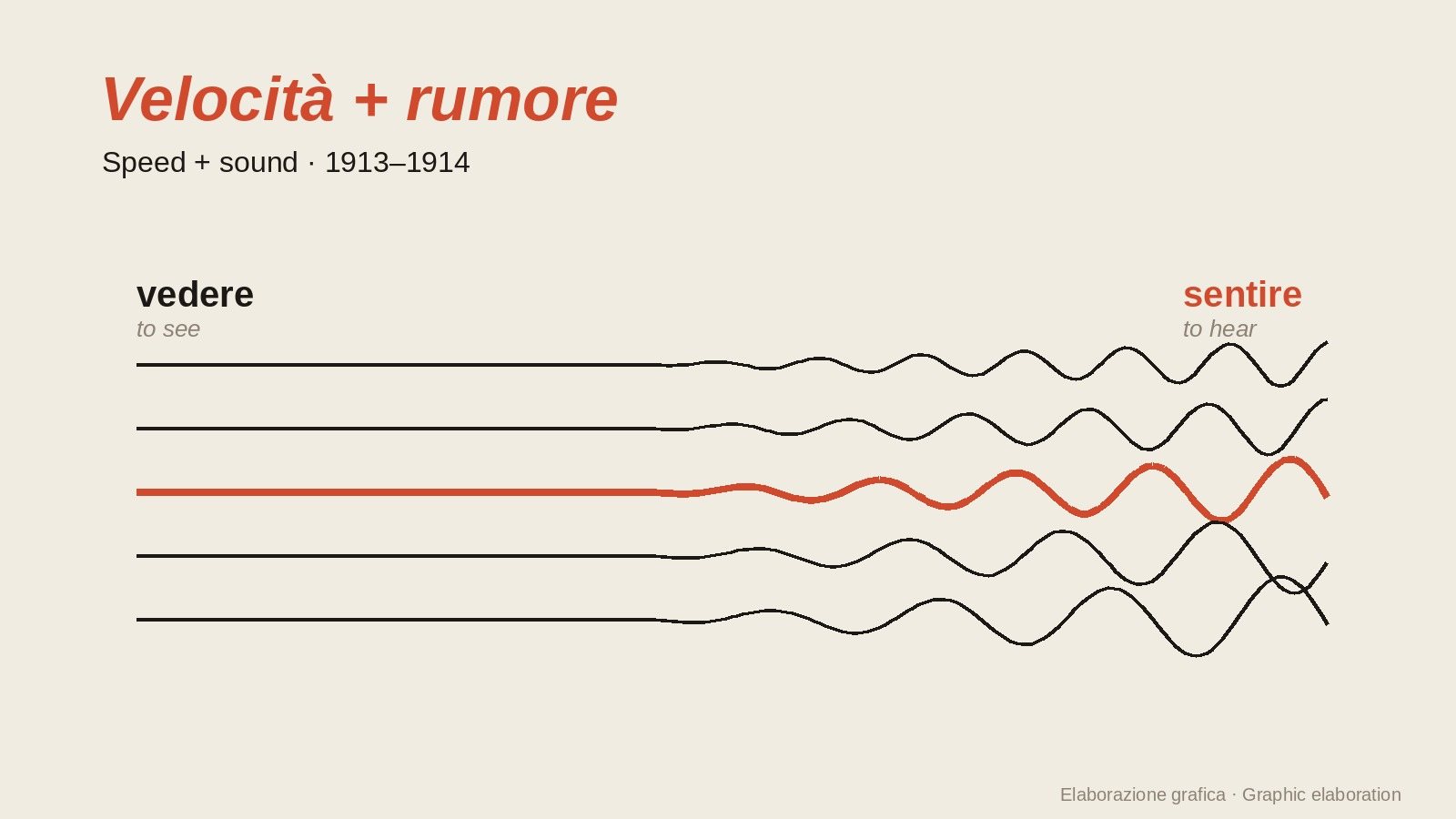
Un'automobile che passa non si vede soltanto: si sente. Il rombo del motore arriva, cresce, si allontana. Nella serie dedicata alla velocità, Balla prova a mettere anche questo dentro la pittura. Il titolo di uno di questi dipinti lo dichiara senza giri di parole: Velocità astratta + rumore.
Il quadro non è esposto in questa sala: ne raccontiamo qui l'idea, perché completa quella dell'opera che avete davanti. Se in L'auto è passata restano le tracce visive del passaggio, qui le linee di forza si intrecciano con forme che evocano il suono: ritmi, onde, vibrazioni che si propagano nello spazio. La velocità non è più solo qualcosa da guardare, ma un'esperienza che coinvolge più sensi insieme.
Non è un'idea isolata. Proprio nel 1913 i futuristi riflettono sul rumore come materia artistica. Luigi Russolo, uno dei pittori che avete incontrato nella prima sala, pubblica il manifesto L'arte dei rumori e costruisce strumenti per suonare i rumori della città e delle macchine. Nello stesso anno Carlo Carrà scrive un manifesto sulla pittura dei suoni, dei rumori e degli odori. L'idea di fondo è che la vita moderna arrivi ai sensi tutta insieme, e che l'arte debba restituirla così.
Balla porta questa ricerca nella pittura. Il movimento, dopo essere stato scomposto e poi dissolto, si allarga: diventa ritmo, quasi musica. È un passo in più verso una pittura che non rappresenta più oggetti, ma esperienze.
L'opera è conservata alla Peggy Guggenheim Collection di Venezia.
English
A passing car is not only seen: it is heard. The roar of the engine arrives, grows, fades away. In his series devoted to speed, Balla tried to bring this too into painting. The title of one of these works states it plainly: Abstract Speed + Sound.
The painting is not on display in this room: we describe its idea here because it completes that of the work in front of you. If The Car has Passed shows the visual traces of a passage, here the lines of force intertwine with forms that evoke sound: rhythms, waves, vibrations spreading through space. Speed is no longer only something to look at, but an experience that involves several senses at once.
It was not an isolated idea. In 1913 the Futurists were thinking about noise as artistic material. Luigi Russolo, one of the painters you met in the first room, published the manifesto The Art of Noises and built instruments to play the sounds of the city and of machines. In the same year Carlo Carrà wrote a manifesto on the painting of sounds, noises and smells. The underlying idea was that modern life reaches the senses all at once, and that art should convey it that way.
Balla brought this research into painting. Movement, after being broken down and then dissolved, expands: it becomes rhythm, almost music. It is one more step towards a painting that no longer represents objects, but experiences.
The work is held in the Peggy Guggenheim Collection in Venice.